
Digital Marketing for Small Business: A Complete Step-by-Step Tutorial
Published: December 15, 2025
From a Canadian digital marketer since 2006
This guide gives you everything you need to understand how digital marketing works for your small business in Canada. And those aren’t just keywords. We’ve outlined our complete step-by-step process to help you use digital marketing to work for you as a small business.
It’s a complete tutorial, guide, or a detailed set of instructions on how to use social media, email marketing, SEO, and your website with digital marketing strategies. It includes tools to use, the mistakes to avoid, and the exact steps we use at Actually.
Actually, we help small businesses move from digital marketing guesswork to implementing actionable, strategic, measurable growth. We want to help you understand the step-by-step process for real digital marketing to ROI — profit, customers, and sales.
We’re not about highlighting vanity metrics for digital marketing. We are all about helping you achieve results for your small business. Since 2006, we’ve helped restaurants, service-based businesses, e-commerce stores, nonprofits, technology and brands get online using one core belief:
→ Small business marketing works when it is strategic, consistent, and SEO-optimized.
→ Knowing the customers’ keywords is a priority.
What is digital marketing for small business?
Digital marketing for small business means using online marketing tools like social media or email marketing to attract, engage, and convert audiences into customers.
Small companies don’t need to use every platform or reach every audience at first. So we recommend, don’t spread yourself too thin and go for quality over quantity. Determine the right platforms for your business, develop a strategy, and maintain a process to keep it up, because it takes consistency, effort, and time.
Time doesn’t mean it takes a long time; it just means it takes time for progress to increase and multiply the effect of the digital marketing strategies.
When digital marketing is done correctly, it creates a predictable, always-running customer acquisition system.
So first, let’s discuss what each digital marketing platform is, why it works, and what it will do for your small business.
Social media marketing
Social media is a free way to advertise your brand and reach your audience.
Platforms include:
Instagram
Facebook
Pinterest
TikTok
LinkedIn
For small businesses, social media can:
Build brand awareness
Provide the benefits of your product or service
Showcases expertise
Share behind-the-scenes content
Highlight products and services
Drive customers to your website, storefront, or restaurant
Remember, using social media doesn’t mean you need to be everywhere on every platform every minute.
You only need to be on the social media platforms where your customers spend the most time.
Your website needs SEO
Your website is your digital storefront.
And SEO is what sends customers to it.
Another way to think about it is that SEO brings customers to the website organically.
The purpose of optimizing your website is to help your customers find you online based on their search intent.
Prioritize SEO before investing in an expensive, robust website platform with many custom features or a complex website design. That’s important too, but it shouldn’t take priority over SEO altogether.
If you have a nice-looking website but have not done any SEO work, these steps apply to you, too. In fact, when you factor in SEO, you might find that the website needs to be redesigned to support the changes—another reason to start with SEO first.
Local SEO Website Requirements
Keyword research
Location-based content and landing pages for locations served
On-page SEO (page titles, page URL, keywords, one H1 per page, multiple H2, H3, H4 in order, internal linking)
Technical SEO (favicon, fast website speed, performance, looks good on mobile, sitemap, structured data)
Connect to social media profiles
Create a Google Business Profile and optimize it
Local SEO is essential for organic search results, so the way a customer finds you organically online is by searching with keywords on a search engine like Google.
The local SEO strategy also helps the business appear in Google Maps for local results and “near me” searches, since Google Maps is based on the proximity of your company to customers seeking the services you offer.
It’s probably a guarantee that if you’re a local service business, you want to be found on Google Maps and in search results, so SEO is essential to achieve those goals.
Advertising with social media
Small businesses can run free and paid ads on:
Google
Facebook
Instagram
Pinterest
YouTube
LinkedIn
Ads are fast traffic.
Social media is a long-term, sustained way to build traffic and online authority and to test ad creative.
The challenge with ads is that they work, but also cost money to run, and for a small business, that can be costly to sustain, especially if you are getting the company started.
Fortunately, there is a more affordable way!
You can design posts, reels, stories, pins and blog articles to look like advertisements. This is how you run free ads on social media before paying for advertising campaigns.
To convert the eyeballs you advertise to into loyal customers:
Understand your audience’s intent
Design the reel, post, pin or story to appear like an ad
Write a hook (to their intent)
Create a call to action (ask them to do something like click a button or DM for info)
Ads drive immediate traffic, while social media builds long-term traffic and authority. The best social media marketing strategy uses both.
Content writing + email marketing
Content is how you inform your audience and attract visitors to your website. Information can be posted on the website about pricing, services, products, the areas you serve, and how to contact you by phone or email.
Email marketing is a way to share this information with a bunch of customers at once. Email marketing software is the tool that helps you send information on your website to a list of interested people, guiding them toward becoming buyers.
Content builds trust.
Email builds conversions.
Together, they turn cold traffic into paying customers.
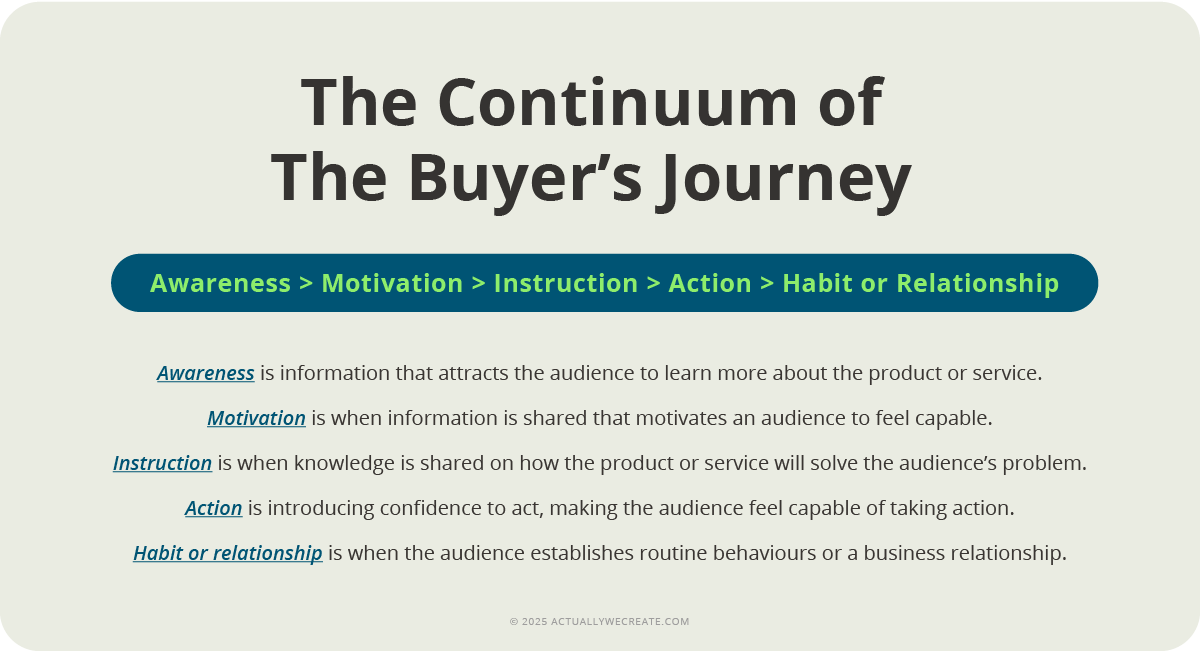
Use a strategic communications continuum to understand the buyer’s journey. The customer starts at the very beginning, when they discover your business online. The introduction could happen through a social media post, an optimized website page with keywords aligned with their shopping intent, and, with a call to action, they are invited to subscribe to an email list to stay informed.
The Continuum of the Buyer’s Journey
Awareness > Motivation > Instruction > Action > Habit / Relationship
Content educates your audience.
Email marketing works to convert them into buyers.
Welcome emails or welcome sequences are pre-designed emails automatically sent to every new subscriber to guide them through the buyer’s journey. This is how content writing leads to email marketing, which leads to email subscriptions.
Email marketing helps guide potential customers who have just signed up for your emails through your company's buyer’s journey.
As a small business, you can use the buyer’s continuum to help write content to use in email marketing to:
Answer customer questions; provide information
Rank for keywords based on the buyer’s intent
Build trust
Increase credibility
Improve sales conversions
Email marketing bridges the gap slowly with drip emails that guide subscribers from awareness to the relationship stage or the point of purchase for the product or service you offer.
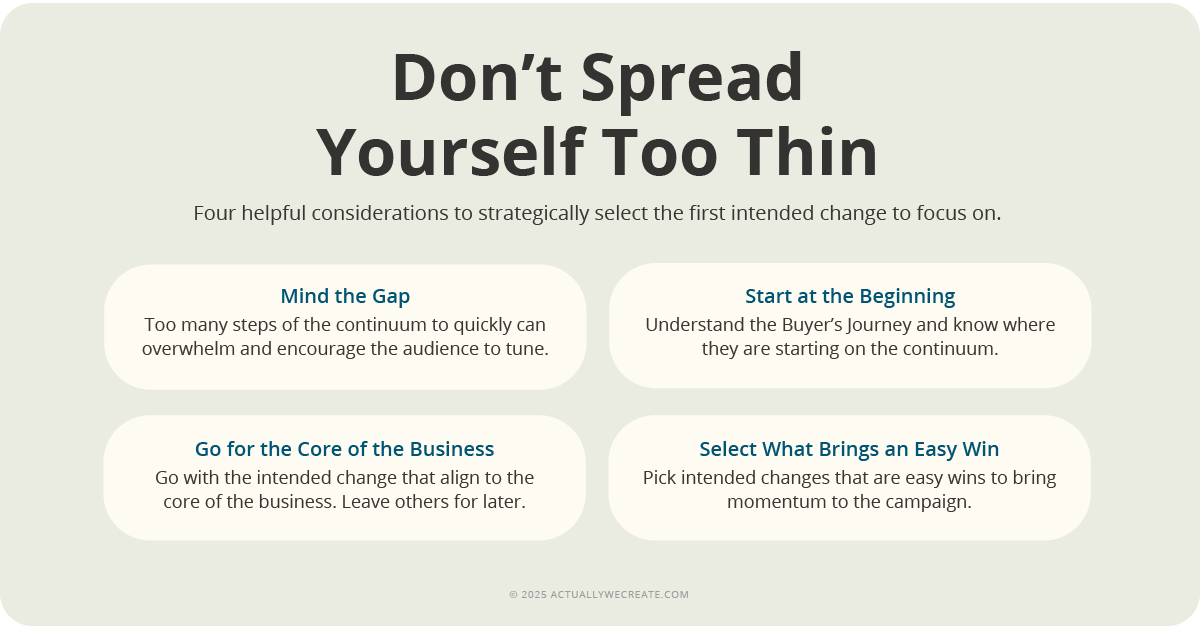
Don’t spread yourself too thin when working on moving an audience through the continuum.
Mind the gap. Start at the beginning. Go for the core of the business. Select what brings an easy win.
Branding
Branding is your small business's identity — the logo, colours, tone, messaging, design, and communication style.
Branding is more than a logo — it’s your entire company identity.
Branding improves recognition.
Branding improves conversions.
Branding includes:
Logo and colours
Tone and voice
Messaging and slogans
Visual consistency on website, signage, and social media posts
Small businesses can brand by going beyond a logo design, using branding colours on their website, social media posts, and other platforms.
Branding helps your small business stand out, be recognizable, and memorable online.
Search engine optimization (SEO)
SEO is how small businesses get found on Google without paying for ads every day.
SEO works because:
It targets people searching for your exact services
It compounds over time
It generates free, regular, organic traffic
It builds authority and trust online
Small business owners can definitely harness the power of organic search, but optimizing their website is a must to benefit.
Email marketing
Email remains one of the highest-ROI channels — with a return of up to $36 for every $1 spent.
It works because:
You own your email list
Algorithms don’t control who sees your content
You can sell directly, consistently, and repeatedly
You can advertise directly to the potential buyer's personal email address!
Small business owners don’t need fancy software to start using email marketing. Platforms like Squarespace let you create the appearance of an email marketing platform, collect their email address, and set it to send all submissions to a Google Sheet for free.
Even if the list is small when you begin, you can send a text-only email to all subscribers. You do not need to learn how to design an email. Text-based emails perform very well, just as well as email designs. In fact, Neil Patel, the expert SEO and digital marketer, regularly sends text-based emails to his subscribers.
You don’t have to wait for an email marketing budget to get started with email marketing; you can use the free tools like those in Squarespace today!
Website design
Your marketing hub — where conversions happen.
The website is the centre of all digital marketing.
The website design must:
Be mobile-friendly
Load fast
Answer customer questions
Have strong CTAs
Be SEO-optimized
If local, needs location information
Use keyword strategy in header tags
Implementing these seven website strategies is how website conversions happen.
Content writing + blogs
Blogs create search visibility, organic authority, trust, and topical expertise.
Blogs based on keyword research improve:
Organic rankings
Search visibility
Trust and authority
Small businesses that publish blogs consistently outperform companies that don’t. If you research your top-ranking competitor, you will probably see that there’s room for your website to rank higher simply because they never publish blogs.
They might not even have a blog, but if they do, when is the last time they published an article? If it’s been a while, that’s great news for you because there’s room for you to move into their ranking and go higher.
Google ads
Google ads generate fast, targeted traffic when done correctly.
Google Ads provide instant visibility for:
High-intent local searches
Service-based businesses
E-commerce stores
Restaurants
Trades
Nonprofits
When done correctly, it is one of the most powerful traffic tools online, primarily when used to leverage specific marketing campaigns for your company.
Digital advertising
Digital advertising is any promotion of the company online.
Paid promotion can be:
Paid top position on search engines
Paid advertisements are shown to audience types on social media before other posts
Ads positioned strategically on video platforms
Display ads of banner ads, images, or videos placed on websites or apps
Small businesses can benefit from ads when they’re targeted, optimized, and continuously monitored.
Digital marketing for small business: in 16 steps
These are the steps we use at Actually to build strategic, ROI-focused digital marketing campaigns for clients.
We use these steps to create predictable, measurable digital marketing results for Canadian small businesses.
1. Plan before you build a campaign
Most small businesses jump into posting without a roadmap.
A solid campaign strategy includes:
Knowing what you’re promoting
Who your ideal customer is
What platforms do they use
Your positioning or how you differ from the competition
Your conversion goals
Your timeline
Your budget (even if it’s small)
What do you want to gain from digital marketing
Your plan should include:
Selecting target audience(s)
Lists of keywords
Competitor research
Content pillars
Budget
Platforms to focus on
Performance goals
Marketing without a plan is guessing. Most small businesses skip this step, wasting time.
2. Audit your current content
Review everything. A content audit quickly exposes gaps or opportunities.
Look at everything and ask yourself:
What’s working?
What’s outdated? (copy, design, metadata)
What’s missing? (keywords, pages, clarity)
What’s ranking? What’s not ranking?
What needs improvement?
This content audit will give you your content marketing roadmap of what to focus on improving.
3. Meet your customers where they are
Don’t post everywhere. Post where your core audience spends time or hangs out online.
Strategic communication methods that move an audience through too many steps of the Buyer’s Continuum can overwhelm them and encourage them to tune out, and require a tremendous amount of resources, so don’t spread yourself too thin.
Examples of meeting customers where they are:
Facebook for local services and community-focused businesses
Pinterest for makers, designers, DIY, décor, food
LinkedIn for professionals, B2B, consulting, services
YouTube for tutorials, reviews, and demonstrations
Trying to reach too many audience types can require a lot of resources to advertise to, so again, don’t spread yourself too thin.
Having a strategic communication plan that maps goals over a 1- or 2-year period can help you focus on creating campaigns that move the buyer through the continuum, building momentum for the broader digital marketing campaign.
Go after the low-hanging fruit first, or the audience that can provide you with the most significant wins first.
4. Monitor your content’s performance
Every piece of content gives feedback.
Data tells you exactly what to adjust.
Reviewing feedback for performance, combined with data, is what monitoring the content performance is all about.
Monitor every post, page, or email opened, and every click gives feedback. Your job? Read it, analyze, evaluate, and respond by making performance changes to the content campaign.
Watch and analyze the following data:
Saves
Shares
Website clicks
Watch time
Engagement patterns
Views or open rates
Your audience will tell you what content they like, but not directly, and only if you pay attention to the feedback.
5. Go where your customers are
Choose platforms strategically based on where your clients are online:
Instagram → Visual brands
Pinterest → DIY, home, beauty, fashion, money, business
LinkedIn → B2B, service-based professionals
YouTube → Tutorials, product demos and long-form video content
Remember, quality content beats quantity. Don’t just “post everywhere “ and include a strategy.
Post strategically by showing up where your customers expect you to be online.
6. Learn more about your customers
To reveal your real customers’ intent and behaviour use:
Google Analytics
Google Search Console
Keyword research tools
Social media insights
Google customer reviews
Surveys
Sales conversations
Marketing improves as your understanding of your customers’ intent and needs improves.
7. Develop a content calendar
A content calendar helps you avoid losing focus, stay on strategy, and maintain consistent keyword usage.
Consistency wins, not intensity.
Quality wins, not quantity.
Use a simple rhythm:
1–3 weekly social posts
1-5 weekly video or reel
1–2 weekly blogs
1 monthly newsletter
Schedule Pins daily
Make your content calendar goals long-term and sustainable, and learn how to perfect it.
8. Listen and respond with respect
Digital marketing is a conversation, not a broadcast.
Engage with:
Comments
DMs
Google reviews
Emails
Emojis are an easy way to respond socially. For some small businesses, a batch of emojis can be part of the brand. When the two are combined, responsiveness becomes the defining strength of your brand.
Response time and tone matter more than most businesses realize.
9. Develop your email list
Your email list is owned data — no algorithm or social media required.
Start with:
A simple newsletter
One lead magnet
One welcome email marketing sequence
Get their email address and send emails to your customers at once. Email is one of the highest-ROI digital marketing solutions — with a return of up to $36 for every $1 spent.
10. Delegate and automate
Use scheduling tools, CRMs and AI to automate digital marketing.
These automation marketing tools will save you time:
Scheduling apps
CRMs
Email automations
AI writing assistants
AI agents
Chatbots
Small businesses grow bigger when they stop doing everything manually or independently.
Use these tools to automate:
Meta Business Suite
Google Calendar
MailerLite
Buffer
Notion
Canva
A CRM
ChatGPT
Automation reduces workload and increases output, helping to ensure you keep up with digital marketing campaigns.
11. Catch the reader’s eye
What’s the hook?
Get your audience’s attention with a strong visual and a witty hook. Then ask them to take an action with a call to action (CTA).
Hooks + CTAs are everything in digital marketing.
Use:
Short intro
Strong headline (hook)
Clear call to action for next steps (CTA)
Generating interest without calls to action or hooks is a wasted opportunity for website traffic.
12. Stay on top of performance metrics
What gets measured grows.
It’s essential to track the performance of:
Posts
Ads
Emails
SEO pages
Website conversions
Small businesses can achieve compounding returns by tracking progress with metrics.
13. Website traffic
Monitor where your website traffic comes from and what pages they visit.
Monitor:
Where visitors are coming from
Which pages they land on
What keywords bring traffic
What content performs best
What source performs the best
Traffic sources can be combined and include social media, organic search results, and AI discovery tools like ChatGPT and Google AI Mode.
14. Conversions
Track how many visitors become customers.
Conversions equal action.
Some examples of conversions are:
Books
Purchases
Fills out a form
Subscribes to email
Calls
Requests estimate
Small businesses should track conversions monthly.
The key is to attach a conversion value to each action.
15. Engagement metrics
Comments, shares, saves, and clicks are engagement metrics.
They show what content your audience connects with when they:
Comment
Share
Saves
Click-through rate
Likes (lowest value metric)
Small businesses should regularly track engagement metrics, especially when running active campaigns.
16. Return on investment (ROI)
ROI is the most crucial digital marketing metric.
Measure:
Revenue generated compared to marketing cost
Campaign profitability
Customer lifetime value
ROI turns your marketing efforts into measurable numbers so you can see what’s working and what’s not.
How small businesses can start SEO campaigns for their websites
The straightforward strategy to succeed in SEO is to rank for keywords that fall within the easy-to-possible range. Once you start ranking for those, move on to higher-density keywords.
SEO helps small businesses’ websites:
Rank locally
Appear in Google Maps
Outrank competitors
Get organic traffic
Build long-term brand trust
Build authority
Reduce dependence on ads
Reduce ad spend over time
Increase phone calls, bookings, and website visits
Remember, SEO works best when:
Keywords match customer search intent
Content is optimized and updated
Backlinks grow naturally
Google Business Profile is active
Many small business websites look beautiful — but don’t rank.
They’re well-designed, but the content isn't optimized.
Keep in mind, SEO is a long game, which is why small businesses ignore it or give up after a few weeks to a couple of months. They think there’s a quick fix, or they don’t bother with SEO at all.
Fixing your website SEO is the fastest way to achieve measurable growth in organic search traffic.
Can small businesses excel at content marketing?
Absolutely! Local businesses can definitely excel at content marketing on their own.
Here are some quick tips to create content marketing that works:
You answer customer questions
Your blogs are optimized for keyword strategies
You use hooks and CTAs
You post consistently
You write for humans AND Google
Local businesses that create consistent, optimized content dominate their markets.
Can small businesses excel at social media marketing on their own?
Yes, but stop posting just to stay active. Start posting with a strategy to increase website traffic and sales. We recommend creating a campaign, posting regularly, staying focused on the strategy, and remaining consistent.
Small businesses use social media marketing for:
Strategy
Visual
Clear
Branded
Consistent
Keyword optimized
Planned, not random
Uses hooks
Includes call to actions
When you stop posting randomly.
Social media can be powerful for small businesses when combined with email marketing and SEO-driven content.
How should a small business start email marketing?
Start simple:
Start collecting email addresses (bonus: collect first and last names to personalize emails)
Send one monthly newsletter
Send a weekly promotion
Create an automated welcome sequence
Starting small builds trust and engagement, increases open rates, helps you get into the groove of sending emails regularly, and allows you to bridge the gap in the buyers' continuum toward repeat customers.
The best starting digital marketing strategy for small business
Plain and simple, your strategy should:
Discover what’s working
See what needs improvement
Identify competitor weaknesses
Benchmark competitors
Increase website traffic
Increase conversions
Track ROI
The best strategy for a small business is to analyze the competition, their website traffic, and use ROI to track and identify what’s working.
Five easy components of an effective digital marketing campaign
Every small business can use digital marketing, either DIY or with a company.
Either way, here are five components for an effective digital marketing campaign:
Consistent content
SEO optimization
Local ranking strategy
Paid ads (when needed)
Data-driven improvements
How can small businesses measure digital marketing success
Easily, you measure success by:
Increased website traffic
Conversions
Engagement
ROI
Sales
Repeat customers
The future: AI for small business
AI is a tool — not a trend.
Artificial intelligence helps small businesses to:
Save time
Automate workflows
Improve customer experience
Speed up content creation
Personalize marketing
Increase efficiency
Refine strategy
Refine content
Generate ideas for hooks and call to actions
AI won’t replace strategy for small business — AI will enhance it.
Digital marketing will help you achieve success
Digital marketing is for every small business; it’s just a matter of determining where your audience is, sending them regular, consistent, branded messages online and getting your website optimized with the right keywords.
Every small business can market its products and services independently with digital marketing.
Or work in a digital marketing company for small businesses to help you execute the tasks.
Some tips to look for in a digital marketing company:
A range of digital marketing services
Expertise that benefits small businesses
A proven system
Clear communication
Has delivered real results for other small businesses
Need help to grow online? We offer transparent pricing and real results.
Explore our digital marketing packages → https://www.actuallywecreate.com/digital-marketing-packages-for-small-business
FAQ Section
1. What is the best digital marketing strategy for a small business?
The best strategy combines SEO, content marketing, local optimization, and consistent social media. We recommend email marketing too. For most small businesses, optimizing the website, ranking on Google, getting reviews, and posting consistently on one or two social media platforms will be the best digital marketing strategy.
2. How much should a small business spend on digital marketing?
Small businesses typically invest 5–10% of their monthly revenue. Many businesses choose a package-based approach for predictable prices.
3. What are the most affordable digital marketing options for small business owners?
The cheapest and most effective options are:
SEO optimized website, web pages and blog content
Social media campaigns
Google Business Profile optimization
Email marketing
Local directory listings (for digital PR or off-page SEO)
These offer high ROI without requiring big ad budgets.
4. Why is SEO important for small businesses?
SEO helps small businesses appear in search results, get discovered locally, increase website traffic, and reduce dependence on paid ads. Ranking on Google builds long-term authority and predictable customer flow.
5. How long does digital marketing take to work for small businesses?
Most small businesses begin seeing early results in 45–90 days, with significant growth in 6–12 months. Ads can produce fast traffic; SEO builds sustainable growth with long-term gains.
6. Do small businesses really need social media marketing?
Yes — social media builds awareness and credibility. Customers often check Instagram or Facebook before visiting a business. Even a simple post, reel or story can increase visibility, reach, and engagement.
7. Is blogging still effective for small business digital marketing?
Yes. Blog content boosts SEO, attracts organic traffic, answers customer questions, and builds topical authority. Most small businesses rank significantly better within 3–6 months of consistent blogging with a keyword strategy.
8. What’s the difference between digital marketing and traditional marketing for a small business?
Traditional marketing focuses on radio, print, and billboards. Digital marketing focuses on Google, social media, content, and email, enabling precise tracking, better targeting, and lower costs.
9. How do I know if my digital marketing is working?
Track results:
Website traffic
Conversions
Keyword rankings
Email subscribers
Social engagement
ROI
If the numbers are improving month over month, your strategy is working. If the results are not improving, the digital working campaign may need a more strategic approach. We recommend taking a closer look at your keyword intent.
10. Can small businesses manage digital marketing themselves?
Yes! 100%! If you have time to learn and consistently apply SEO and content strategies. Many businesses start DIY, then partner with an agency as they grow. DIY is great for long-term, sustainable growth and also teaches the business owner how to work effectively with their digital marketing company on strategy.
Turbocharge your small business growth with digital marketing
It’s time to get online, get optimized, and get competitive.
When you partner with Actually, you get:
A proven digital marketing system
Expertise built for small businesses
SEO-driven content and strategy
Clear communication
Real, measurable results
Strategic digital marketing.